

Toomey
McClellan
France
Mousson
Austria
Wildungen

Introduction
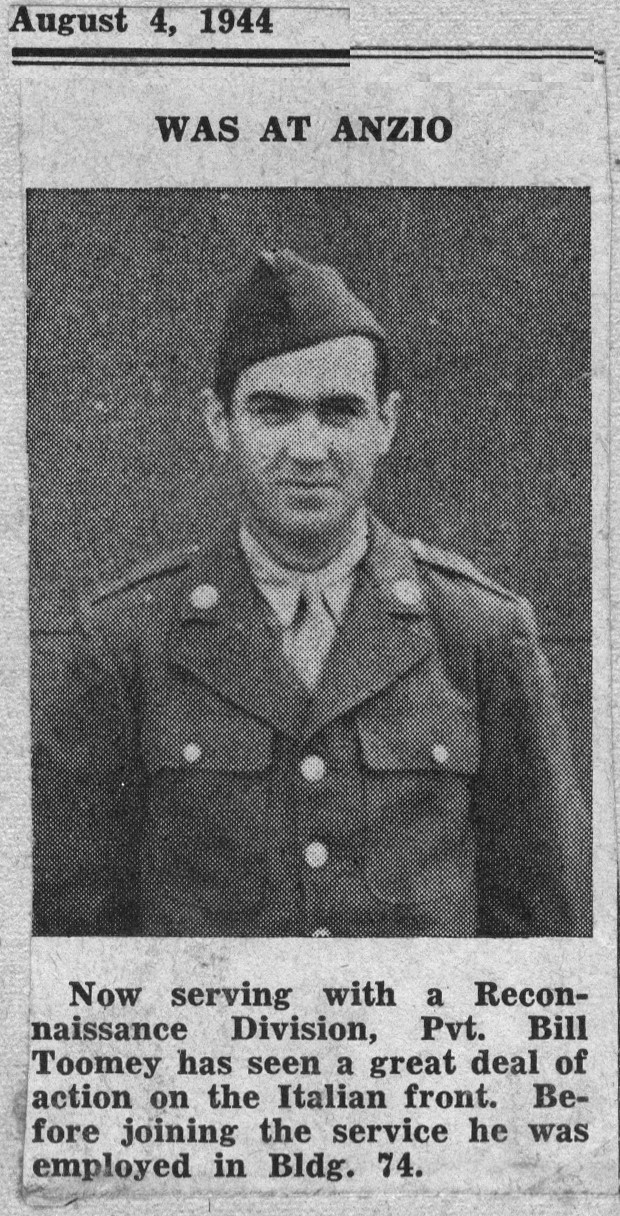
Many WWII veterans kept silent about their experiences in the war, my father spoke rarely about the great conflict he experienced in 14 months of combat during 1944 and 1945. For most of those months he wore the patch of Official U.S. War Photographer on his shoulder as a member of a five-man photographic team formed on the Anzio beachhead which he joined in Rome in July of 1944.
Prior to this assignment, Bill Toomey became a member of the 3rd Division on Anzio in February 1944, first assigned to the 15th Regiment as a radio operator and then volunteering to join the 3rd Reconnaissance Battle Patrol. The Battle Patrol was mostly in reserve at Anzio but swung into action during the late May breakout toward Rome. Although my father, who passed away in 1981 at the age of 64, was never able to answer the questions I later came to have about his service and, of course, was not able to verify what recollections I have of the stories he told me that I recount here, I have in, good faith, attempted to reconstruct what I have come to know of his war experience.
There is a unique knowledge I carry of this experience that comes in the form of over 700 photographs that my father brought home from the war. I have come to find out that these photographs represent about half of those taken and processed by his photo unit. And so I was able for many years to view my father's experience through his eyes and of the men he served closest with. In recent years I researched the content of the photos and developed the Internet site www.dogfacesoldier.org that tells the story of these five photographers and the 3rd Division in which they served.
 Reluctant Warrior
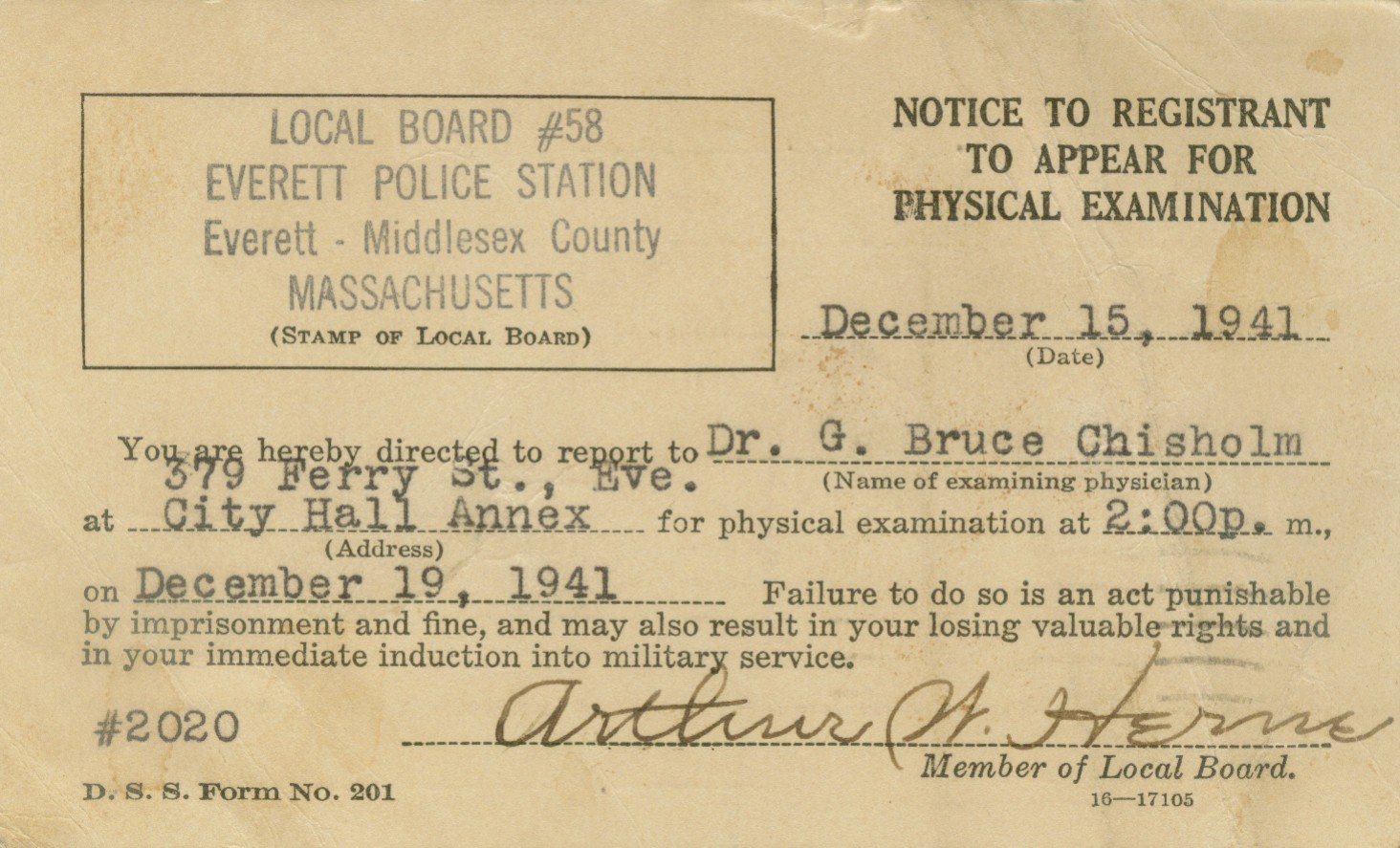
Draft Notice: December 15, 1941.
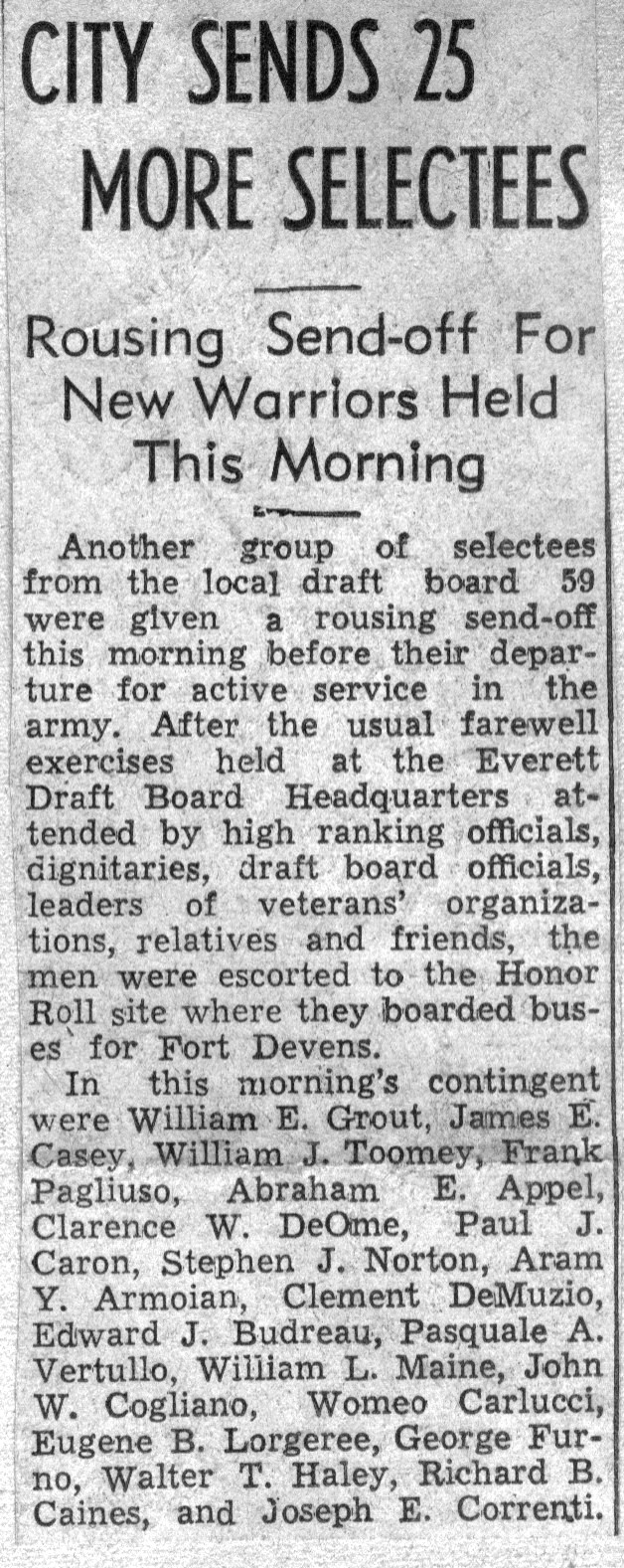
My father, William J. Toomey, graduated from Everett, Massachusetts High School in 1936. He was the editor of his class yearbook. He worked at the Dorchester Argus-News from 1936-1941. Before induction "Bill" worked at the General Electric River Works in Lynn, Massachusetts. He married his high school sweetheart, Rose M. Judge (class of 1938) on Nov. 29, 1941 and fathered his first child Elaine on Dec. 30, 1942.
My father reported to the Everett City Hall within two weeks of the attack on Pearl Harbor to undergo physical examination for the local draft board. In January 1942, he was deemed fit to join the Army. With a newborn, my father made several appeals to the draft board. He worked as a printer and photographic assistant for the Boston Post that deferred his induction until August 26, 1943 at Fort Devens, Massachusetts. His training took place at Fort McClellan, Alabama and Fort Meade, Maryland. He was at Anzio and briefly garrisoned Rome with the 3rd Division. He later went ashore with Operation Dragoon in southern France. Battled in the Colmar Pocket and crossed the Rhine River to turn south at Bamberg to battle through Munich and Nuremberg.
My Father's Stories
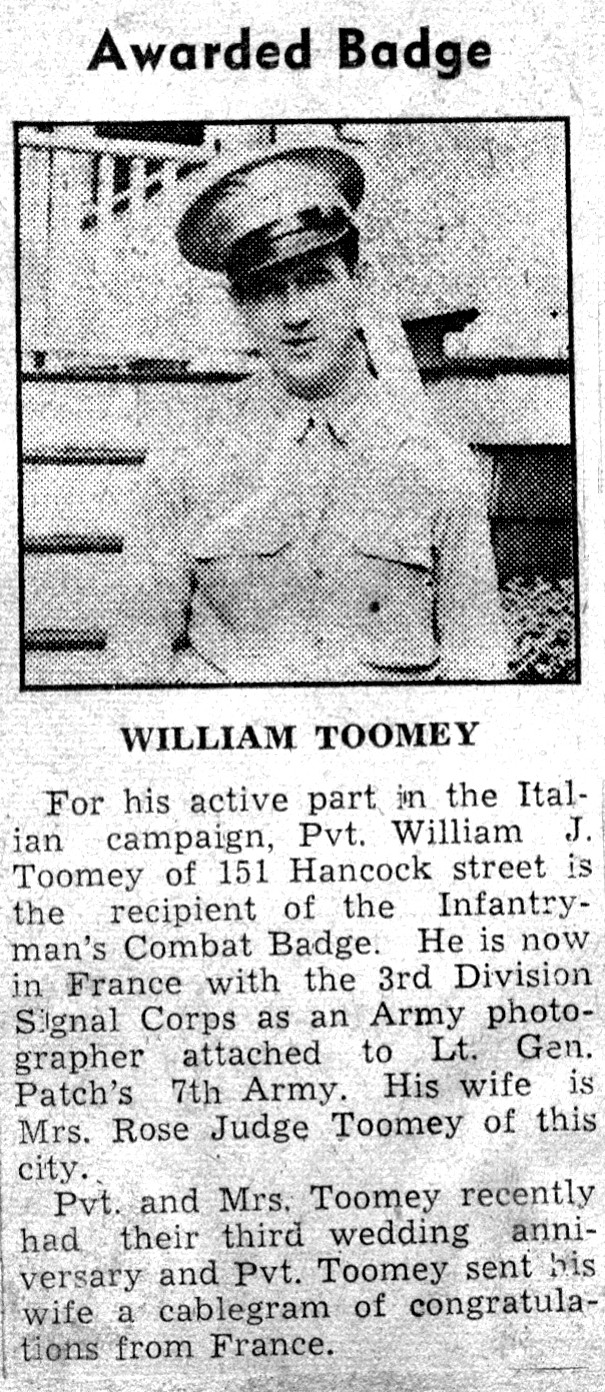
I believe that the combat stories my father told me of, that I reveal here, occurred during the breakout from Anzio when he was a member of the 3rd Reconnaissance Battle Patrol. When he served as a photographer, he was not directly involved in combat and these stories are of combat situations, I have come to this conclusion. My father received the Combat Infantry Badge for his service at Anzio and the breakout to Rome, and if fate had gone differently, would have also received a Silver Star as you will read below. He was awarded a Bronze Star in 1945 for the work he did with the 3rd Signal Company.
A Ticket Home
While on the beachhead at Anzio, my father's unit, The 3rd Reconnaissance Battle Patrol, came under one of the constant artillery barrages that plagued and haunted the Allied defenders. My father and those around them took cover in their foxholes which was the thing to do when the shells starting landing. One of the soldiers had left his helmet sitting up on the edge of his dugout and as a shell or two came dangerously close, when the shooting stopped the GI emerged to find his helmet a serious victim to shrapnel with severe dents and cuts. The soldier looked at the faces around him, put the helmet on, screwed up his face a bit and announced he couldn't hear a thing and that he had his ticket home as he headed off to the medic. As my father recounted, "Damned if that S.O.B. didn't get a few weeks of bed rest in Naples just for observation."
Valmontone, Italy 1944
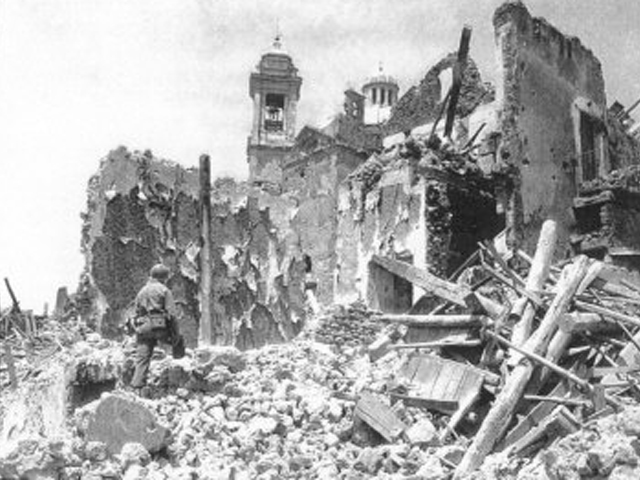
The brawny hands of an American army sergeant tugged at a bell rope in Valmontone's Cathedral at 6 A.M. today ringing the hour of liberation for 100 civilians, policemen and two priests who had remained throughout the Allied assault on the key town on Highway 6.
A famed beachhead reconnaissance patrol "The Snoop Troop" led by Lieutenant Frank W. O'Connor, Jr. of Silver Springs, Maryland moved into Valmontone at the first light of day today without firing a shot.
It's tall stone walls shattered by Allied bombs and shells, Valmontone lay seemingly dead on a little knoll between the railroad and Highway 6 through Via Casilian which goes winding northwest 20 miles to Rome.
When Sergeant John Samples of Johnson City, Illinois, rang the bronze bell in the shrapnel scarred tower of the cathedral of Santa Maria, Valmontonians poured out of a deep shelter under the palace next door.
Many American lives were lost in yesterday's attacks of infantry and armor against Valmontone's defenses, but during the night the Germans withdrew the bulk of their artillery and tanks protecting the highway.
Lieutenant Walter Gill of Roswell, New Mexico, scouted one part of the town; Sergeant James McGee of Daly City, California, another. When they reported to Lieutenant O'Connor on the cathedral steps he had his "Human Radio Station", Pfc. Edward Collins of Portland, Oregon send this message to H.Q. on a walkie Talkie, "Have Valmontone, what next?".
The cathedral was damaged, but still structurally sound. The adjoining palace and many other buildings were hard hit.
A debonairly mustached policeman in a red and blue uniform and tri-corner hat, told me fifty German soldiers were killed by the American air attack on Valmontone May 25.
Just one week ago, the Fifth Army's tank spearhead drove from the old beachhead to the outskirts of Valmontone. Since then the Goering Division resisted fanatically and held the escape route open for the German Tenth Army retreating from the southern front pursued by the British.
"After that," he said, "the German commander moved his men outside town. Some of our people, including refugees from Rome, have remained here the whole time. This week two were killed by your shelling but those who stayed below the palace were safe. Now they would like food."
Just one week ago, the Fifth Army's tank spearhead drove from the old beachhead to the outskirts of Valmontone. Since then the Goering Division resisted fanatically and held the escape route open for the German Tenth Army retreating from the southern front pursued by the British.
Now our forces are fanning out in the green valley to the north of the Alban Hills and a brigadier general said: "It's true, the Germans are cracking fast."
I had finished looking at the cathedral's torn paintings and the pile of dusty silver crucifixes and candlesticks behind the bare marble alter, when two shy Italian girls appeared. They were almost panic stricken when one of our cub artillery planes flew over and then a crash of a German shell nearby made them wince, but they finally asked the question: "We are from Rome, when will Rome be free?"
Daniel DeLuce
June 3, 1944
Boston Post
Others participating in this event were:
Pfc. William A. Sweeney of Worcester, Massachusetts and Private William J. Toomey of Everett, Massachusetts
Field of Poppies
As the Snoop Troop moved toward Rome during the Italian Spring of 1944, they found themselves moving through a field of poppies described as over head high. The sun was warm and there appeared to be bees flying overhead among the flowers. This became questionable however when an occasional flower top would come falling down from overhead. The patrol was moving cautiously forward and eventually the buzzing and the falling flowers ceased. The mystery was solved when my father and those walking forward with him reached the edge of the field to rise up an embankment where they discovered what was a German machine gun emplacement put out of action by the soldiers moving ahead of them.
Silver Star
From the Anzio Beachhead my father s unit was ordered to advance to a village and hold the position until being joined by a larger unit traveling an alternate route. It was an uneventful walk until within site of the village, a Messerschmidt forced the squad of about 8-10 men to take cover in a culvert. The airplane continued circling and kept the soldiers pinned down by firing a few bursts from its gun as it passed until their patience wore out and they devised a plan to send two soldiers at a time for the cover of the buildings ahead. The timing was calculated for the airplane to make its turn to return to a firing position. At the right moment, two by two, the squad made it safely into the village.
The village was unoccupied and as time passed it seemed that the unit that was scheduled to rendezvous was going to be a no show. Night was falling and the weary GIs decided to spend the night by throwing up a barricade in the direction of the enemy and mounting it with a .50 cal. machine gun they had carried with them. Sentry shifts were divvied up and the C-Rations and cigarettes helped pass the night away.
Early in the morning, still being the sole defenders of the village, an American jeep approached with a full-bird colonel looking for the combined team he expected to find in the village. After cussing a bit at not finding what he expected, he took a hard look at the sleep-deprived soldiers and their machine gun and asked, "So you are telling me you entered the village and set up this defense as you waited for reinforcement?" After a quick "Yes sir," from the squad leader he continued, "Did you not have any idea that the whole God-damned German Army is just a mile or two down that road? And you sat here all night defending the village from the enemy?"
Sitting there keeping an eye on the gun, smoking cigarettes and shooting the breeze didn't seem like such a brave thing to do but the colonel was impressed enough to announce he was going to write them up for a Silver Star.
For whatever reason, the award never came about, and at least as far as my father was concerned it was fine with him. He had told me he saw enough guys with their guts shot out and limbs blown off to know that they were the heroes who deserved the medals and not a bunch of guys passing the time trying to get some sleep in a small Italian village even if the whole God-damned German Army was just down the road.
Pozzuoli, Italy
While the 3rd Division was preparing for invasion of southern France in July and August 1944, my dad seemed certain that one of the young laundry girls was Sophia Loren. She was born in Rome in 1934 and would have been nine years old in 1944. She grew up in Pozzuoli with her mother, sister and grandmother.
Otto Skorzeny in Captivity
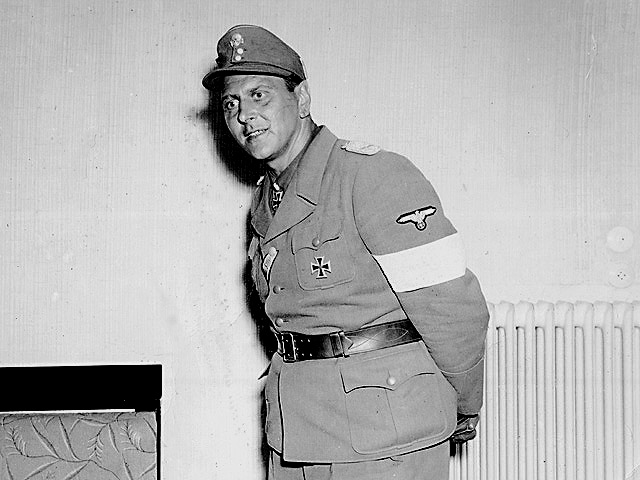
Colonel Otto Skorzeny was called the most dangerous man in Europe by the Allied Army. He was an SS commando who assisted in the snatching of Benito Mussolini from his mountaintop prison in Italy, headed the force of American impersonators that infiltrated during the Battle of the Bulge and is rumored to have led a squad of frogmen in an attempt to destroy the captured bridge at Remagen.
In the final days of the war, Skorzeny emerged from the Austrian countryside and surrendered to the American Seventh Army through the 3rd Division.
My father held his camera steady following the tall German officer s every move. Skorzeny paced making quick turns being careful to keep his face away from the camera and keep himself constantly moving. In the end my father s patience outlasted the SS colonel's resolve and the shutter had its victim. For a moment it would seem my father was the most dangerous photographer in Europe.
The Dogface Soldier
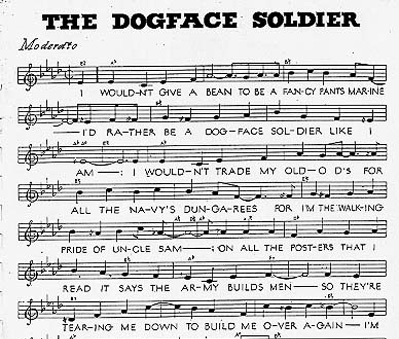
One thing I will always be indebted to my father for is that he taught me how to sing the 3rd Division's theme song, Dogface Soldier . I was always in amazement when he would smoothly croon the song and it is truly the time he was most proud of his service in the war. His performances were many and I carry with me a rich memory of them and my copy-cat ability to bring the song to life once again.
My father was at his proudest when he began the song: "I wouldn't give a bean, to be a fancy-pants Marine. I'd rather be a dogface soldier like I am." And finished up with a rousing: "So feed me ammunition, keep me in the 3rd Division. Your dogface soldier boy s O.K."
The Dogface Soldier
"I wouldn't give a bean to be a fancy-pants marine.
I'd rather be a dog-faced soldier like I am.
I wouldn't trade my old O.D.s for all the Navy's dungarees,
For I'm the walking pride of Uncle Sam.
In all the posters that you read,
It says the army builds men.
So they're tearing me down
To build me over again.
"I'm just a dog-faced soldier
With a rifle on my shoulder,
And I eat a kraut for breakfast
Every day.
So feed me ammunition
Keep me in the 3rd Division.
Your dog-faced soldier boy's o.k."
William J. Toomey |
Introduction
Fort McClellan |
Anzio-Rome
Southern France |
Vosges
Pont-A-Mousson |
Germany-Austria
Bad Wildungen |
Epilogue
|