
Staff Sergeant
Charles O. Beardslee
Prelude
Signing Up
Africa
Sicily
Italy
Anzio
Southern France
Vosges
Colmar Pocket
Wounded
Going Home


How I Answered the Call to Serve My Country

S/Sgt Charles Owen Beardslee.
When I was growing up, I was taught that it was a man's duty to defend our great nation against all aggressors. In 1940 and 1941 Our government did not want to get involved in the war that was going on in the east. Japan had been an aggressor for over five years or more and had taken Korea and was advancing in China with little resistance.
The United States was losing many ships at sea. In fact we had lost a hundred and fifty ships that carried lend lease war materials to England, Russia, and China. I hope you can see that we were very tolerant with these aggressors, but then on December 7th 1941 the Japanese bombed Pearl Harbor and destroyed a large part of our Pacific Fleet. Things changed in this country not over night but in a matter of hours. People that were in the Army, Navy, and Marine reserves were all called up within the hour and were in uniform before the day was over. The following day, December 8th 1941 the President Roosevelt and Congress declared war on Germany, Japan, Italy and all their crumby little allies.
Things were happening so fast, what was said to be true one day was no longer true the next. All men ages 18 through 45 had to register for the draft. I registered for the draft about the fifteenth of December. Wages were frozen and so were jobs A person could not change jobs without a good reason and approval by a labor board. Food clothing and gasoline were rationed. All big ticket items like cars, refrigerators, furniture and many other articles were no longer available as factories converted to producing war materials. Even rents were frozen
There was no excuse for an able bodied person to be out of work. If you weren't working at a job you had better be wearing a uniform. While we were converting everything for war the Japs were busy defeating us everywhere in the Pacific, our most tragic defeat was when we lost the Philippine Islands.
Exciting changes were taking place. You had to have lived during this time to feel the tremendous power of this great nation coming together like it did. I felt I was unable to take part because I was still trying to finish my last year in high school even though I was twenty years old. I had spent the year before in the Army because I joined the National Guard at sixteen in 1937. The President had put all the National Guard in the Army with just a stoke of his pen, but my three years were up before war was declared.
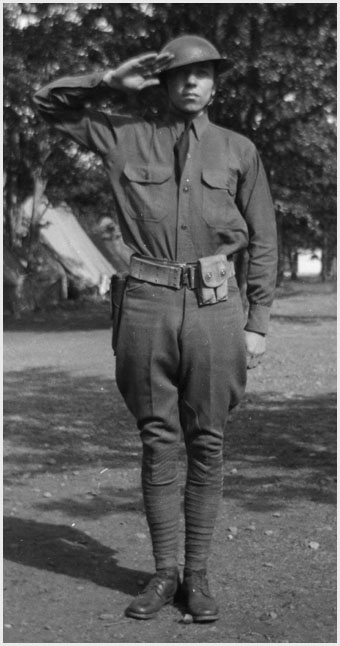
Serving in the National Guard and the Army 1937-1940

Pre-war tank parade
I was back in school trying to finish because I knew I wouldn't amount to a pinch of anything without that diploma. Many young men dropped out of school to join the service. One person I knew that was 18, went to Canada and joined the Royal Canadian Air Force. He was killed during the Battle of Britain before I had graduated. Another fellow joined the Merchant Marine and his ship was sunk and he was lost at sea after only six weeks.
I certainly felt like an idiot going to school, and sitting there studying silly stories by William Shakespeare and dissecting grasshoppers and frogs. It seemed so stupid and I was frustrated and nothing seemed to make sense. When the world was falling apart and I was doing nothing about it I was just getting by with a "C" average because it was difficult as the news brought us nothing but discouraging news of one defeat after another.
We must remember that during WWII the cost in lives lost to both Allied and enemy nations was more than 22 million military lives and millions more in civilians. We also must remember that the war engulfed three-fourths of the planet earth. Thousands of ships were sunk in the oceans and major waterways with their cargoes and men. There were hundreds of cities completely destroyed and thousands of aircraft blown out of the sky with the loss of plane and crew. This was a tremendous time to have lived but we must do everything to keep it from happening again.
Never Volunteer for Anything!
On about the seventh of June 1942 I graduated from high school. The following Monday I went to the Air Force recruiting office and asked to enlist. I told them I wanted to be a tail gunner or whatever they had to offer in the way of flight crew positions. I didn't want anything on the ground and be stationed somewhere 200 miles from the action. I was given a physical and I failed. They said that since my upper incisors were false I couldn't hold the oxygen tube, mouthpiece properly.
After wasting most of the day at the recruiting office I was home feeling very unhappy because I really wanted to fly. That night I thought over what I would do next. The following day I went to the Marine recruiting office and they gave me another physical and I was washed out because they said I had a potential hernia. From that day on I have disliked the Marine Corps for not being able to recognize the fighter that I knew I could be.
Again I went home licking my ego wounds and feeling sorry for myself. After a couple days of sitting around I concluded I had to lower my standards considerably.
The next day I went to the Navy recruiting office. I was getting desperate. I didn't want to be left out of this war. We were all living in a very exciting period and I wanted to be part of it. The Navy recruiter gave me a written test that was easily passed. Then I was given a test for color blindness that I failed and they said, "Sorry but we can't use you, we don't want people who are color blind." I thought that was stupid since the Navy painted everything gray, how could one possibly make a mistake. I wasn't disappointed about not getting in the Navy, but I was disappointed knowing that I failed three times to enter our armed forces.
I gave up trying to enlist and resigned myself to going through the duration of the war as 4-F and so I started looking for a civilian job. I first went to Boeing Airplane Company. They were advertising for help with full-page newspaper ads. The starting pay was 65 cents an hour. Several people I knew were working there. I went to the plant employment office where I was given a test on my ability to read blueprints this I passed with no problems and then they said I had to take physical exam that I promptly failed, again because of my potential hernia.
A couple more days went by as I contemplated what to do. I next went to the Bremerton shipyard because they were also doing a lot of heavy advertising in the local newspaper. They were paying a dollar an hour to start, but again I failed the physical. God, you would think I had lost an arm and a leg. I was most certainly thoroughly disappointed not only was I going through the war as a 4-F but I couldn't even get a job to support myself. In high school I considered myself somewhat of an athlete. I was on the track and swim teams and I also used to work out in the weight room. I broke no records but I was there participating.
Finally one day by accident, I heard that the Army Port of Embarkation was looking for heavy-duty truck drivers. I was now getting so desperate for a job I think I would have taken a permanent position cleaning toilets.
My heavy-duty truck driving experience was very limited. I had only driven a few trucks in the National Guard but I had to give it a try I was sent to the transportation division for a driver's test. When I arrived they brought the biggest truck I had ever seen, it had a ladder on the side to climb up into the cab which had a seat at least six feet across. It was a wrecker the Army used to retrieve disabled tanks from the battlefield I got behind the wheel, started the engine.
I scraped the gears a couple of times as I tried out my smoothest double clutching. This must have impressed the examiner because I only went about four blocks, when he said, "that's far enough your driving is good let's go back to the garage." At least I had passed the driving test and had a clean valid driver's license. I thought this was all that would be required, they said I needed a physical, my heart skipped a couple beats until they said I had to pay for it myself.
I took the form they gave me to my family doctor. He didn't waste any time filling it out, he took only about two minutes and handed it back to me and wished me good luck. I took it back to the port office and was hired. I started to work the next day and the pay was the best I had ever heard of, I started at a dollar twenty-five an hour. I was ecstatic, after all my previous disappointments.
After working at the port only six weeks, I received a notice from my draft board to appear for a physical and draft classification. I thought this would be an effort in futility after all my other failures to get into the service. I thought for sure I would be classified 4-F. Everyone knows that meant you were unfit physically for military duty. It was only three days after the draft board examined me that I got my classification in the mail. I couldn't believe what I was looking at, right after the word CLASSIFICATION was a big 1-A.
I could hardly believe it but at least my draft board thought I was not a cripple. Only five days later I was notified by letter to report for induction. Things were happening fast. I reported back to the draft board where about a hundred of us were loaded aboard two busses and were taken to the induction center in Tacoma, Washington.
Almost Airborne
We spent four to five hours at the induction center probed in varying degrees in our bodily orifices. After all my prior problems, I was amazed that they found me so healthy. After the physicals we were sent to another room where we all stood raised our right hands and swore in an oath to defend our country against all enemies. I was very happy and proud to say, "I do". We spent the final portion of our induction listening to an Army captain read the which we were told, we were now soldiers in the Army and we must obey these laws from this time forward or we would be subject to court marshal.
After spending the day at the induction center we were all given two weeks leave in order to settle civilian affairs. I went back to work for about ten days out of the fourteen we were given and I asked for all the overtime I could get because my pay was going to be reduced from $65 a week to $50 a month. My last few days at home were spent saying goodbye to all my friends and relatives in between sleeping late, playing basketball and swimming.
On Sunday evening there was a farewell dinner and on Monday morning I left to report for duty. About three hundred had gathered at the train depot and boarded the train for the 45 mile trip to Fort Lewis, Washington.
On arrival we were divided into about four smaller groups each with a corporal in charge and each group was taken off in different directions. My group was issued uniforms first and was given instructions as to how to send our civilian clothes home. After we had completed this task we were all taken to an infirmary where we were given our shots, after which we all went to lunch. After lunch were marched over to a barracks-like building where we were given our aptitude and I.Q. test. It was very hot in the room and the shots I was given before lunch was starting to have an effect on my disposition. It was difficult to read and think. I'm sure it lowered my score by five points but even with my head spinning dizzily and being near nausea, I managed to squeeze out a score of 118.
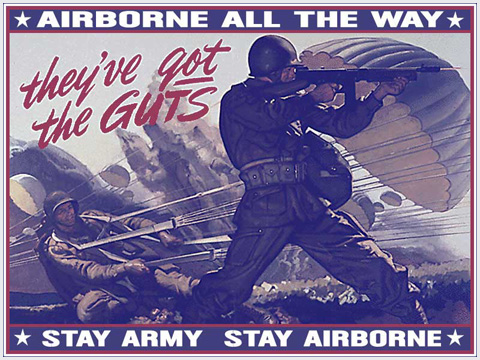
Airborne recruiting poster WWII
After the test was over, everyone was informed that those that scored 110 or better could volunteer for paratroop basic training. This sounded like a good idea since paratroopers got extra pay for jumping, and also got to wear those great looking jump boots. Only five out of the three hundred volunteered. Two days later the five of us that volunteered found ourselves boarding a train with tickets in one hand and a fist full of food vouchers in the other.
Our destination was the 504th Parachute Regiment stationed at Camp Taccoa, Georgia. We were all very excited and proud that we were going to be part of this special group. We arrived around September 20 and the very next day we were sent to the base hospital where we had to take another physical. Naturally they found out about my likeliness to have a hernia. Just like that I was washed out.
God I was discouraged and disillusioned but Allen Mabbutt, who was drafted with me in Tacoma, was also washed out. He had a healthier attitude about it and kept me from feeling so depressed with his good humor and optimism. There were about a hundred of us washouts sitting around waiting to be re-assigned. Allen and I waited about two weeks, tensions were high in this wait and see and I managed to get into a couple of fist fights.
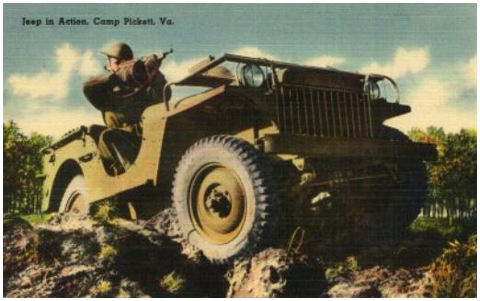
Post card from Camp Pickett, Virginia
About October 10, five of us rejects were put on a train and told our destination was Camp Pickett, Virginia. When we arrived we found ourselves as replacements in the Third Infantry Division. We were needed to fill out the ranks before the division left for overseas. This was agreeable to me because it meant I would not have to go through basic training. Both Allen and I were sent to the 30th Regiment's First Battalion HQ Company. When First Sgt. Johnson took my papers and signed me into the company roster it was the best feeling I had had in a long time. Finally, I really belonged to an organization that wanted and needed me and didnŐt send me off to get another physical before I could get accepted.
So it would be that just eight weeks after I was inducted into the Army I would found myself wading ashore into Africa with the Third Division. As for my appetite for action, little did I know that the Third Division would hand me my fill by being in more campaigns than any other division in the war. After all was said and done, I found that the Third was the greatest and I was proud to have been a part of it
Reporting for Duty in HQ Co. 1st Bn. 30th Inf.
After being assigned to HQ Company, First Battalion I was taken by jeep and driver to the barracks. I thanked the driver for the ride and went inside. I introduced myself to the First Sergeant. First Sergeant Johnson was the typical picture of what first sergeant should look like and I found him to be very professional and he knew his job well. I handed him an envelope that contained all my records. I was given a choice of where I could go within the company of either the motor pool to be a jeep driver since my National Guard discharge listed experience as a truck driver or I could join the anti-tank platoon.
I picked the anti-tank platoon because, while in the Guard, all drivers did the kitchen, latrine and guard duty. I later found out it was just the opposite in this organization. Now I ask you how unlucky can a person be? It was my own fault for not asking. I was told to report to Sergeant Trembly. When I finally found him he told me I would be in the second squad and that Corporal Leaser would be my squad leader.
Off I went then to find Corporal Leaser. After I found him he told me to go to the supply sergeant and draw my equipment. I was issued a pack, ammo belt, gas mask, shelter half, mess kit, canteen, blankets, and many other items but my biggest surprise was I was given a 1903 rifle. It was a good rifle for WWI but I was going off to fight WWII. I thought they had been marked obsolete, but I was told not to feel badly as they were now used as sniper's rifles when fitted with a telescopic sight.
I was still disappointed and angry about the rifle particularly when I saw the jeep drivers with all new M1 rifles in leather sheaves strapped to the side of their jeeps. I knew they wouldn't be used by a driver as much as someone that was going to be a combatant. I didn't think it was fair and complained quite bitterly about it, but it didn't do any good. At least I guessed that I wasn't going to be a sniper since I was never issued a scope.
After a few days I was told that I was going to be the platoon runner. I didn't have the slightest idea of what was expected of me but if they wanted someone to run I was their man. We spent about two weeks on physical conditioning but even with all the activity I gained about five pounds mainly because we had the best cook and mess sergeant in the Army. Sergeant Whitehead really knew his job and did it well. He only cooked food that was good or else he made it taste good.
Charles O. Beardslee | Prelude | Signing Up | Africa | Sicily | Italy | Anzio |
Southern France | Vosges | Colmar | Wounded | Going Home
Memoir appears by permission |